
Best Laid Plans
Execution matters and the art of getting things done
The chances are you are falling behind. You started the year with big ambitions, like building an export sales business, but, somehow, you’re drifting and perhaps have already missed a key deadline or two. The problem is, it is cumulative. Missing one deadline puts achieving the other goals at risk. In fact, you may never recover. In today’s hyper-competitive world operating at ‘Internet-speed’ that could prove fatal. So often it is not the best business idea or technology that wins, but the one that gets to market first. It is all about execution. As Ash Maurya, Austin, Texas-based entrepreneurism guru says:
We all get the same amount of time credits each day (24 hours). What separates us is where we invest these credits.
As a business partner, mentor, investor, and author myself, I have a lot of demands on my time and my time – like yours – is limited. Here are six approaches I use:
1. Have a plan forward: The first step is to have a plan. I have met so many startup founders, and even managers of large, established businesses, who have only the vaguest notion of a plan beyond a statement of “we’re going to finish our MVP this year” or “we intend to launch our product at this or that trade show”. Actually, these are objectives or aspirations, not plans.
So what is a plan? The dictionary defines a ‘plan’ as “a detailed proposal for doing or achieving something” or “an intention or decision about what one is going to do.” Note the verbs “doing”, achieving” and “going to do”. Plans are about actions. When the plan is well executed you should be in a different place that you are now.
The overlooked, yet crucial part of the plan, is what happens before: the planning. This is when you “decide on and arrange in advance” the things you need to do. You need to determine the purpose of the plan (your objective or goal) and the steps (activities or deliverables) and arrange them in a sequence that makes sense.
Many organizations make their plans and decide their budgets for the next business year in the last quarter of the previous year. It is a good discipline, but the mistake is to then set them aside. The document is filed, never to be read again. Circumstances change – more about that later – so planning is actually a rolling, ongoing process.
Start by writing down the plan. Each activity in the plan should have a delivery date by which it must be completed. I have seen too many overoptimistic plans in my career. They might look great at a project review, but the effect is to stress out and demoralize those tasked with executing them. In the end, someone is on the hook for the work. I have also seen plenty of plans, which are not ambitious enough. It’s a fine line. Your judgment call is to set dates that are realistic and achievable. A little stretch is good, but too much risks failure.
In assigning tasks, pick one task manager to drive to each activity and make him or her responsible for completing it. I often see action items assigned to pairs or groups of people, but this is a mistake. Too often one or both will believe the other is taking ownership with the result that progress is slowed, or worse, nothing happens. “Oh sorry, I thought you were working on it!” In the world of Slack or Lync that really should not happen.
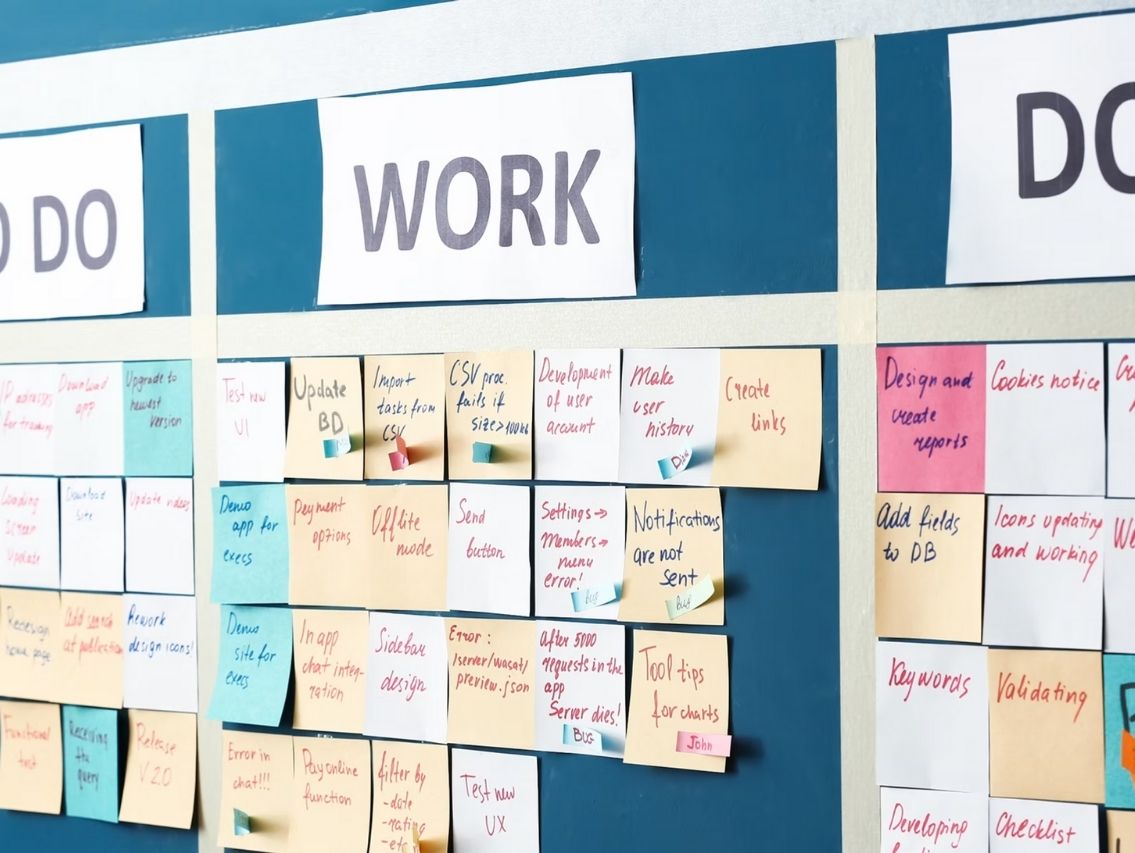
2. Find tools that work for you: Tracking where you are against your plan is vital to effective execution. There are a plethora of tools and techniques you can use. A simple spreadsheet (in Apple Numbers, Microsoft Excel or Google Sheets), which maps out activities and the progress being made, can be made more impactful using traffic lights: include a column with cells coded red for ‘no progress’, amber for ‘matter in hand’, and green for ‘done’. That way you can quickly see where the red issues are and determine what to do. Devote time to exceptions. There is a certain satisfaction to being able to change red activities to green, or to striking through them: you can see tangible progress from your efforts! Celebrate the achievement!
Particularly complex projects can be broken down into checklists to atomize tasks to ensure completion. Thirty-day plans can add other insights: list what must be done in the next 30 days, then review them at the end of the month; any unfinished tasks become the ‘to dos’ in the next month along with new activities earmarked for the following 30 days. The point is to execute and ensure nothing is omitted. Years ago I heard of a project to hold a press launch for an important and high-profile new product: the team diligently worked on the news release, sales collateral, embroidered shirts, booked the room, catering and the rest, only to learn 3-days before the event that they had omitted to invite any editors! A detailed checklist would have prevented that oversight.
There are many sophisticated, shrink wrapped, off-the-shelf applications, such as Monday.com and Trello, that be very helpful in ensuring tasks are carried out. The key is never to lose sight of the big plan: see the wood and don’t get lost among the trees.
3. Learn, be flexible, adapt: It used to be said that “small is beautiful”. People in large organizations often look longingly at upstart rivals for their seeming ability to react quickly, but don’t realize the multiple burdens each team member bears, and the long hours they work; yet those in the startups often look longingly at the incumbents for the wealth of resources they perceive them to have, yet underestimate the policy constraints under which people working there operate. In reality, no one has it easy.
As a leader, you can help. Teams that foster and reward a learning culture, in which members have a curiosity about the context and alternative problem-solving approaches, are better able to be flexible and adapt to changing demands. Learn from your insights and act on them. Be willing to change course, be ready to abandon tasks that do not add value, and embrace failure as a part of achieving success. Remember the goal of the plan.
4. Understand reasons for delay: The point of regularly tracking progress is to quickly identify where the problems are. It is not about assigning blame.
Project management techniques are particularly valuable in this regard. Tools – such as Microsoft Project – make you map out activities against time and show their interconnectedness. What emerges is the critical path, the series of activities that will take the longest time to achieve – or looked at another way, this analysis determines the shortest time possible to complete the project. It may be longer than you anticipated! The lead time to order and take delivery of test data or to complete a legal review, for instance, may prove to be the unanticipated activity that slows down progress on all other deliverables. Then you can decide if applying more resources will shorten the path, or if the overall plan may need to be adjusted. If the plan objective is to pitch at an investor event or to demo a product at a trade show, use project management to work backward from that event to determine where the critical path is. The reward in saved sleepless nights is worth it!
5. Have a contingency ‘Plan B’: You have probably heard the maxim “No plan survives contact with the enemy.” (The full quote is: “No plan of operations extends with any certainty beyond the first contact with the main hostile force” and it was Field Marshal Helmuth Karl Bernhard Graf von Moltke who wrote it.) Circumstances change. They can upend the best-laid plans: the client you have been courting decides to take a different direction; the product development process hits a significant roadblock; a compelling opportunity comes along, but you don’t have the bandwidth to take it on without stopping work on another. As a founder or entrepreneur, you constantly have to make these tradeoffs. In my own career, I was often frustrated at not being able to run an opportunistic tactical promotional campaign, or attend a trade show, or present at a conference (which I had not anticipated during the planning process), because it had not been budgeted. No pay, no play.
One way to deal with the unplannable is to have a contingency. You could earmark part of your budget – say 5 or 10% – for unforeseen activities. You should be ready to assign someone to drive the activity – an existing team member, or temporarily hire the talent. In any case, budgets inevitably underestimate true costs; they are, after all, best guesses, so having a contingency is good in any case. During your planning process consider how different scenarios might play out and develop a ‘Plan B’.
6. Use your time wisely: The default is to hold weekly, monthly, or quarterly meetings to track progress. The problem is this approach builds in lag; if the team meets bi-weekly, progress tends to work to a 14-day rhythm. Urgency is lost.
Crucial to achievement is to communicate with other stakeholders and task managers as often as needed to get the work done. Stay focused. In Agile methodology, in the relentless pursuit of meeting goals determined by project scrums and sprints, teams may need to meet and account for progress at daily stand-ups. It’s intense, but it is really effective.
It remains to state the obvious, now you know execution matters, get on with it! Or as we say in Texas: “get ‘er done!”
Lindsay Powell is a partner of ATXponential and a passionate advocate for entrepreneurism. Follow him on Twitter @Lindsay_MCIM